A number of people have asked me, after my last post, if I´m doing alright, and if I have enough water, and should they worry about me? I´m fine. My host family is lucky in that we get water for at least two hours a day, and we have a big cement holding tank, so we just let that fill up and use the water throughout the day. Even with nine people in the house we´ve never gotten to less than one-fourth of the way full.
Also, the rain has started so, now we can just set out garbage cans, and barrels, and buckets, and they fill up fast. Like really fast. And they tell me that this isn´t anything yet. I spent four years in Oregon, I thought I knew rain, but this is a different beast. It´s not constant yet, but it will be, and apparently when it is, it will be pouring like I have never seen, as opposed to the steady, but reasonable amount of Oregon rain. This will be an absurd amount of rain...speaking of absurdity, have you ever seen a wet chicken? It is the silliest looking thing ever. That´s all for now.
Saturday, May 7, 2011

Saturday, April 30, 2011
Water´s for Fighting
It was a normal afternoon at site-me sitting in the Casa Materna chatting with the pregnant ladies; one of the doctors from the health center writing down blood pressure, belly measurements, fetal heartrate; the smell of burning trash filling the air-but there was something tense in the atmosphere. A sense of desperate anticipation that had been mounting since the day before had us stiff in our rocking chairs. It was the doctor who first noticed, necessity no doubt lending him superhuman senses, so that he looked up from his paperwork and gasped,¨"viene el agua," before sprinting out of the room to next door where he started yelling for someone to bring him a barrel. I, along with the fastest moving pregnant ladies I have ever seen, started grabbing empty liter-and-a-half soda bottles to fill up and save for later. The water was back on.
We were able to fill up the several dozen soda bottles and two barrels about the size of a ten year-old in the hour before the water was shut off again, only to be turned on again at some undetermined hour the next day. That was two weeks ago. Since then the water situation has gotten worse.
When I first came here I wondered why my host family, with perhaps the nicest house in town, complete with tile floors and a large t.v., would choose to use latrines and bucket baths. Now I know that toilets don´t flush and shower heads don´t drip when there´s no water, and there hasn´t been water for quite some time. Río San Juan has one of the longest and wettest of the rainy seasons in Nicaragua, but we still suffer from water shortages in the dry season, and the Casa Materna was down to just two liters a few days ago. When the water was turned back on a few days ago no one was around to notice, and it all fell on the ground, and it´s been difficult to bring water in from outlying streams.
Dishes are sitting unwashed in the sink and cooking is difficult since even rice, beans, and tortillas all need water to prepare. The women have to go to the stream to bathe, and numerous of them have contracted UTIs, and since they are all in their last month of pregnancy this can be a dangerous problem, and I don´t even want to think about what would happen if one of them slipped and fell in the stream.
Two days ago, during a meeting with the health center, the director suggested building a well for the Casa Materna, and I silently wondered how I had been so slow as to not even consider the idea. It won´t be easy. True to Peace Corps philosophy of sustainable development, I would have to make sure I was working with the community as opposed to for them, so I´d need their full support. That means community meetings, estimations, supplies, someone who actually knows how to build wells, and waiting until the end of the rapidly approaching rainy season to begin construction, but I am very anxious for the community to support the idea.
I am almost scared to write about this on here, because I don´t want to get other people´s hopes up along with my own, but I feel as if someone keeps whispering "well" in my ear every five minutes. The gestation period will be long, but I hope that before my time here is done, the Casa Materna will have a beautiful baby well.
Saturday, March 26, 2011
How Radio Disney Saved a Bus-full of Nicas...
...and one very patient Peace Corps Trainee from a not so patient PCT. This is the story of the bus ride from my site visit in Rio San Juan back to the capital Managua.
In the very early morning two weeks ago I woke up and dressed by the light of my headlamp, took my bag, and woke up my host brother to walk me to the one direct bus from my site to Managua. The one that brought me there was an actual touristy bus with comfortable seats and a television. I was under the impression that I would be on the same bus on the way back. I was wrong. Before me stood a big yellow school bus that probably had failed to pass safety regulations in the U.S. ten years ago, and so was sent to Nicaragua to die.
Under the yellow light of the only open pulperia, or cornerstore, in town Ismael and I said sleepy goodbyes, and I claimed a seat on the bus. I looked at my watch. 3:50am. Surprisingly though, I felt good, and forty minutes later we passed the next town where another Nica 55 trainee go on ready to return from her own site visit. Then we sat. The busdriver, the yeller, and the cobradora all got off the bus to eat breakfast, go to the bathroom, or take a nap, I´m still not sure, but they left us waiting for fifteen minutes. It was a sign of things to come.
An hour later we arrived at the departmental head of San Carlos where I had a quick breakfast of coffee and a piece of bread, and chatted with the other trainee. Then it was back on the bus, and we were off...for five minutes, until we had another arbitrary fifteen minute wait, after we had just been sitting in the bus terminal for thirty minutes.
This is when things started to go bad. I had not planned well for the trip, and brought no food with me for the ten hour bus ride, thinking I would be so tired I would sleep most of the way. I had not counted on the school bus, nor on how crowded it would be, so that I was forced to stand when I gave up my seat to a mother and child. The other trainee was the first, actually, to give up her seat, and when I pointed out a free seat to her I was surprised to see her standing again only minutes later.
"The guy next to me threw up, and then other people started too," she explained, "I don´t do well when people around me get sick."
Usually one of us had a seat while the other was standing so we were able to switch off a few times, but by this point, about four hours in, I was a foul cloud of grumpiness. My plummeting blood sugar, lack of sleep, the bumping of the unpaved highway, and the resulting dust that coated my hair and face, along with the blaring ranchera music drilling its way into my unwilling skull made me hate everything and everyone. Especially the people squished up against me, and the chicken that little girl was holding. Did you pay for your ticket, bird? I thought not. I´m going to have the cobradora take care of you, and then I´m gonna fry you up and eat you, you flapping nuisance.
Then, miraculously, like the sun coming out from behind the clouds, the bus driver changed the station to Radio Disney (to be said Rahdio Disnehy), and instead of nasally trumpets suddenly the bus was filled with all the cheesy Spanish-language pop my little corazon could desire. Chino y Nacho, Selena Gomez, and Tito el Bambino, along with all my other guilty pleasures came to keep me company. Then next thing I knew, a gentleman gave up his seat for me, and I spent the rest of the hours drifting between sleep and the serenades of teenage heartthrobs until two in the afternoon when we pulled into Managua, took a taxi to the Peace Corps office, then on to the hotel where I took the most satisfying shower in my whole life.
And even the chicken was spared...at least until dinner.
Saturday, March 19, 2011
Site Placement and Visit
On my 23rd birthday, I, along with the forty-three other health volunteers found out where we would be living for the next two years. We had received information over the possible sites, then had an interview with our programming director asking us what we were looking for in the site, and everyone was obsessing about which sites they wanted and which they would hate to get.
During my final site interview I put the information away, didn´t mention any specific sites, and only stated what I wanted in a site:
climate didn´t matter
being the only PC volunteer in my site was ok
I wanted to do a lot of trips to outlying communities
smaller was better
I wanted to work in a casa maternal
internet had to be available within at most two hours.
After the interview, I systematically when through the information about the sites, trying to determine which site my programming director, Ximena, would pick for me, based on the criteria I had stated. I figured that she would put me in either near Jinotega to the north, or in Rio San Juan to the south. During the site placement ceremony, by the time Ximena got to my name on the list, I pretty much knew what she was going to say next, and I was put in Rio San Juan.
I was happy, it fit with everything I wanted, but I was also suddenly terrified as the reality of two years in this place that I only knew of from a piece of paper hit me. It was overwhelming, especially when I read further in the information and realized that it was a ten hour bus ride from the capital to my site. I knew it was isolated, but I´m not sure I knew it was that far away, and it´s not really that far away, it´s just that the highway isn´t complete, and travel over dirt roads makes the going rough. But my experience with the trip there and back is another story, now I present to you my new home.
 |
 |
Ana, she´s in charge of education at the health center. |
 |
One of the doctors from the health center, and the little girl from the farm. She never did tell me her name, she just giggled and looked away… |
 |
...just like this. |
 | ||
| Picking guayaba. |
 |
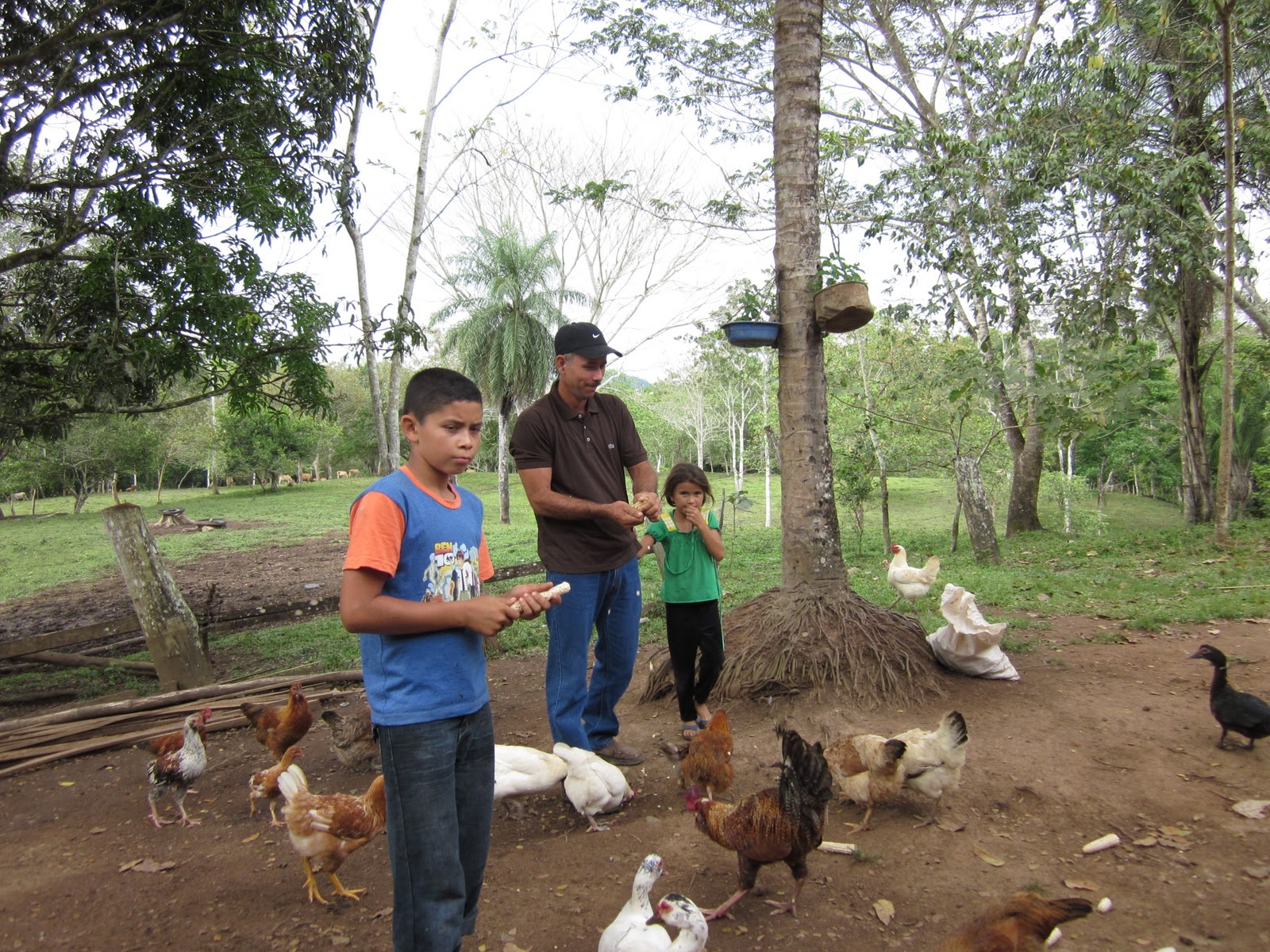
They dye the chicks pink so no one will steal them. |
 |
We then went to a poza, which was fun. |
 |
| Two of the doctors from the health center where I will be working. |

 |
It is a rural community, meaning that there are animals everywhere. |
 |
As we hiked the hour and a half back to the actual town, we ran into a party and this man decided he wanted to sing…just for me. That is an awkward smile right there, also Dr. Chileno there, encouraging the guy on…thanks for that. |

Despite my occational moments of panic, (which are apparently normal at this stage of training), I think I will be happy here for the next two years.
Sunday, February 13, 2011
The First Month
This month I have:
- Eaten more beans and rice than I ever have in my entire life
- Gone to bed by 8pm most nights
- Had three-ish women´s group meetings
- Created and implemented a community survey
- Invited myself to a girls´ volleyball practice
- Subsequently hit two people in the head with a volleyball
- Given one charla (talk) to the women´s group, and one to patients at the health center
- Learned about many technical topics like childhood development, illnesses, pregnancy risks signs and factors, etc.
- Learned about the theories behind non-formal education, sustainable development, and facilitation
- Listened to way too much 80´s-90´s pop
- Tried to call home (I hate Claro)
- Cried
- Laughed
- Made friends
Saturday, January 29, 2011
Community Integration
Community integration is one of the foundations of Peace Corps, seeing as how two of the goals of PC is to learn about a culture and share your own. That can´t happen without a community accepting you. Also, you´re not going to get any work done if no one in the community trusts you. This is especially hard for someone who is shy and doesn´t talk a lot in English, let alone Spanish. Even though I´ve been trying to go out of my way to talk and meet more people, last night I walked into a room where my host mother, sister, and brother were all laughing, and as soon as they saw me, they stopped. I felt so...different. They didn´t do it to be mean, and they´ve been very kind to me. I´m just not part of their club.
So today, during a session in Masaya with the other health trainees, I volunteered to participate in a roleplay of community integration. I thought I should challenge myself. There were only five ¨volunteers¨ out of the fourty-four people there, everyone else roleplayed the community. We five were give no instructions other than to integrate, and we were given pamphlets on STD´s, condoms, and pregnancy. When we reentered the room, everyone else was formed into four groups who were talking amongst themselves.
I first went to a group of ¨campesinos¨ working a field, and asked if I could help. Someone gave me a hoe and I started to ¨help¨ them out, I tried engaging them in conversation, but most were laughing amongst themselves or listening to the other volunteer as he handed out the pamphlets about condoms. One community member told him it was offensive and refused to talk to him. Another community member mentioned that he had a sick son. I asked him if he had taken him to the health center. He told me he didn´t know where it was, so I offered to show him. Everyone was still giggling at the fact that we were just pretending, and then the bell range to switch groups.
The next group was gathered around a main person who was leading a discussion. I introduced myself to one person on the side, and asked what they were doing. She told me it was a bank meeting. Then I asked if I could sit in, she said yes, but to reach the only open seat I had to cross in front of the whole circle. Not the most graceful entrance, but it got everyone´s attention, so I introduced myself and asked if I could help or just learn about what they were doing. Someone asked if I could give then money. I said I could help raise some funds if they had ideas. Then someone suggested a bake sale, but they needed supplies, so someone else took out a loan for them. In everything I´ve been reading, this is the kind of help that is best, when you just mediate ideas from the community, but I´m not even sure if I did that. I didn´t feel very involved at all.
The next group was awful. Just awful. A classroom full of twelve-year olds gossiping and not paying attention at all. Plus the ¨teacher¨ was the man in charge of technical training, someone I should try to impress. He mentioned that they liked candy, which should have been my cue to pull out an imaginary bag of goodies, but I was too distracted by the maddness before me. Confidence might be an issue of mine as well. It got worse when another volunteer showed up and tried integrating as well. I´m not even sure I was able to tell them my name.
The last group was my best, I feel. It was a group of pregnant ladies, just the kind of group that I will be working with when I am an official volunteer. I started again by introducing myself to just one person, and asking if I could sit with her. Then I introduced myself to some of the other woman once I actually sat down and they notice me. At first they asked me a ton of questions: How many children do you have? Are you married? How old are you? Each time they were horrified with my answers, ´So old to not have children!´ So I tried to ask them the questions, like if this was their first child or if they went to the health center for check-ups. One woman said this was her first, but that she couldn´t go to the health center in her condition because it was so far away. She told me that she relied on the advice of the other, more experienced, woman. Went I asked another woman, she told me this was her sixth pregnancy, and that she helps the other women. I asked if we could meet sometime later to talk, saying that I had some information I would like to share with her. Then I handed her the pamphlet on pregnancy. She passed it to the next woman, who passed it to the next woman, who passed it to me. As she did she whispered, ´we´re supposed to be illiterate.´
´Then we´ll just talk later´ I said. Then the bell rang, the exercise was over, and we all returned to our seats.
The facilitators asked if anyone had any comments, and someone from the bank group congratulated the volunteer who figured out that they met once every two weeks, and organized to meet them again next time. And then I thought that I probably should have done that. Then someone from the pregnant ladies group called me out, saying I did the best, and another person commented on how I found the natural leader and organized to work with her, which was great.
I´m glad I got outside my bubble and volunteered. I learned to start small, and focus on questions...also to figure out meeting times. I feel more motivated to interact more and integrate myself more fully into this community. It was exhausting, but it was good to practice for the reality, which does not end at the ring of a bell.
Sunday, January 16, 2011
First Impressions
After delays in D.C. due to snow, I have finally arrived in Nicaragua. Instead of going to Granada as planned, our three day orientation retreat has been in Managua, in the Best Western situated directly across from the airport. I was actually in the first group to reach Nicaragua, since after the snow canceled our flight they had to scramble to get us on other flights, and splitting us up was easiest. We left the hotel in Arlington at 1:30am on Thursday and arrived the same day in Managua after detouring to Panama. The first eight of us arrive a day earlier than everyone else so we were able to go to Peace Corps headquarters, meet the Country Director, do our languange interviews, and recieve our first vaccines (typhoid and flu).
Since then all 44 of us have been busy learned about what it means to be a Peace Corps Trainee and what will happen during our three months of training. I just found out who my host family is, and I will be leaving tomorrow with three other trainees to the little town of Dolores, which is just outside of Jinotepe, another small town just fourty minutes outside of Managua. We are all Health trainees, but this is the first time in Nicaragua that the Peace Corps has split the groups so that one, called Health Lifestyles, will focus on HIV/AIDS and reproductive health, while my group, Maternal and Child Health, will be working in Casa Maternas and with children from ages 0-5 years. In previous years they have been combined, so I am excited to be in the pioneering group. Go Nica 55.
P.S. I just hit the spell check and everything (except Nicaragua) was highlighted, apparently it´s set to Spanish, so please excuse any typos my sun-soaked brain has missed.
Subscribe to:
Posts (Atom)